
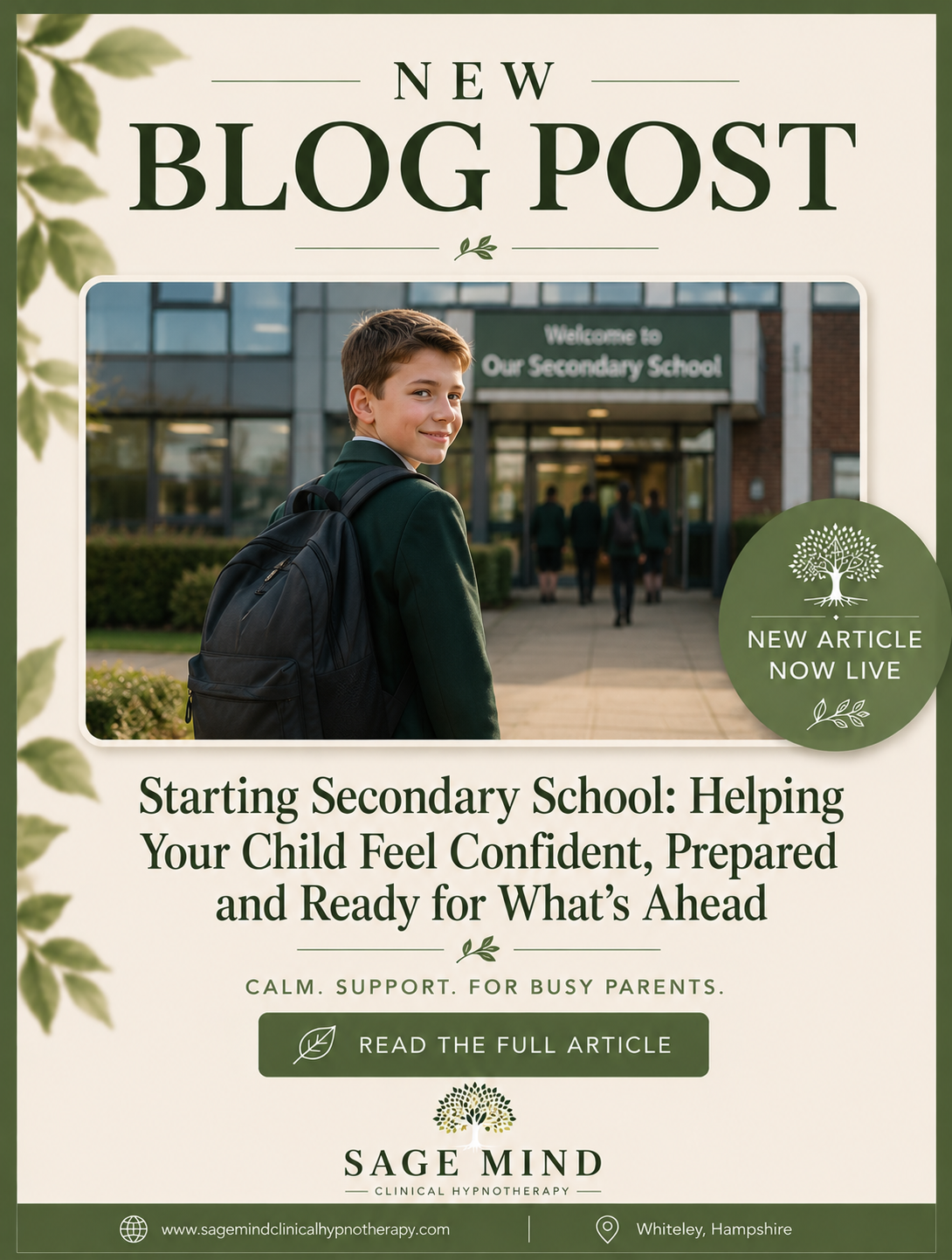
Starting Secondary School: Helping Your Child Feel Confident Through One of Life's Biggest Changes
Starting secondary school is one of the biggest milestones in a young person's life.
For many children, it is exciting.
A new uniform.
New subjects.
New teachers.
New opportunities.
A chance to grow.
For others, it feels overwhelming.
The school is bigger.
The pupils are older.
The timetable is more complicated.
Friendships may change.
Everything suddenly feels unfamiliar.
Many children experience both excitement and anxiety at exactly the same time.
Parents often do too.
At Sage Mind Clinical Hypnotherapy, based in Whiteley and supporting families across Fareham, Southampton, Portsmouth, Hampshire and online throughout the UK, we understand that moving to secondary school is not simply about changing buildings.
It is about helping children feel confident enough to step into a completely new stage of life.
Why Secondary School Feels So Different
Moving from primary school to secondary school is often the first time children experience significant independence.
Instead of spending the day with one teacher, they may move between different classrooms.
They have new subjects.
Different expectations.
Older students around them.
Greater responsibility.
Even practical things such as remembering where to go next can feel like enormous challenges during those first few weeks.
For adults, these changes may seem manageable.
For an eleven-year-old, they can feel huge.
The Worries Children Do Not Always Say Out Loud
Children often worry about things they never mention directly.
Instead of saying,
"I'm anxious,"
they might ask:
"What if I get lost?"
"What if everyone else already knows each other?"
"What if I forget my timetable?"
"What if I sit on my own at lunch?"
"What if I can't do the work?"
"What if older children pick on me?"
Sometimes they ask no questions at all.
Instead, parents notice changes in behaviour.
Perhaps your child becomes quieter.
More emotional.
Irritable.
Clingier than usual.
Restless at bedtime.
These behaviours are not necessarily signs that something is wrong.
Often they are signs that your child is processing a very big change.
Friendships Suddenly Feel More Important
One of the biggest differences between primary and secondary school is the growing importance of friendships.
Many children worry less about lessons than they do about belonging.
Will someone sit with me?
Will I make friends?
What if my best friend ends up in a different class?
Will people like me?
These worries are deeply human.
Feeling accepted is important to us throughout life.
For children entering secondary school, those feelings can seem especially significant.
Helping your child understand that friendships often take time to develop can reduce some of the pressure they place upon themselves.
Parents Often Carry Their Own Worries
Parents rarely stop worrying simply because their children are growing older.
In many ways, the worries simply change.
Will they be safe?
Will they make friends?
Will they cope with the workload?
Will they ask for help if something is wrong?
Should I step in or give them space?
Watching your child become more independent is something many parents feel proud of.
It can also be surprisingly emotional.
Growing up means needing us differently.
Not less.
Differently.
Confidence Is Built Through Experience
Many children believe they need to feel confident before starting secondary school.
In reality, confidence usually comes afterwards.
It grows every time they find the right classroom.
Every new friendship.
Every challenge they overcome.
Every day they realise:
"I managed yesterday, so perhaps I can manage today too."
Children do not need to begin secondary school feeling fearless.
They simply need enough reassurance to take the first step.
Confidence grows from doing difficult things, not from avoiding them.
Change Can Feel Uncomfortable and Still Be Positive
One of the most valuable lessons children can learn is that feeling nervous does not mean something bad is about to happen.
It often means something important is about to begin.
Secondary school brings challenges.
It also brings opportunities.
New interests.
New friendships.
Growing independence.
Skills that will stay with your child for years to come.
Helping them understand that both excitement and nervousness can exist together often removes the pressure to feel brave all the time.
Helping Your Child Feel More Prepared Before September
Although you cannot remove every uncertainty, there is a great deal you can do to help your child feel more prepared before they walk through the school gates.
The aim is not to make every nervous feeling disappear.
The aim is to help your child believe:
"I can cope with this."
That belief becomes the foundation of confidence.
Visit the School if You Can
If your child's new school offers transition days or open evenings, make the most of them.
Walking around the building.
Finding key classrooms.
Locating the toilets.
Seeing where lunch is served.
Understanding where they will be dropped off and collected.
These simple experiences help make an unfamiliar place feel more familiar.
When something feels familiar, it often feels much less frightening.
Encourage Questions
Children often keep worries to themselves because they do not want to appear frightened.
Create opportunities for gentle conversations.
You could ask:
"What are you most looking forward to?"
"Is there anything you're wondering about?"
"If you could change one thing about starting secondary school, what would it be?"
Listen without immediately trying to solve every concern.
Sometimes children simply need to know that someone understands how they are feeling.
Practise Everyday Independence
Secondary school brings greater responsibility.
Helping your child practise small tasks during the summer can quietly build confidence.
For example:
- Packing their school bag.
- Reading a timetable.
- Organising homework.
- Using public transport if appropriate.
- Managing a morning routine.
- Looking after their school equipment.
These are life skills as much as school skills.
Every small success helps children feel more capable.
Keep Expectations Realistic
Many children believe they must make lots of friends immediately.
Or know exactly where everything is on the first day.
Or understand every lesson.
Remind your child that everyone is learning.
Everyone is finding their way.
Everyone feels uncertain sometimes.
Confidence grows over weeks and months, not within a single morning.
What If My Child Is Anxious on the First Day?
Many parents worry that tears or nerves on the first morning mean their child is not ready.
In reality, first-day nerves are extremely common.
Encourage your child to focus only on the next small step.
Putting on the uniform.
Walking through the school gates.
Finding their tutor room.
Saying hello.
They do not need to cope with the whole school year before breakfast.
They only need to cope with today.
Breaking a big challenge into smaller pieces often makes it feel much more manageable.
When Friendships Take Time
One concern many children have is making friends.
Parents often worry about this too.
It helps to remind children that friendships rarely develop instantly.
Many lasting friendships begin with simple conversations.
Sitting next to someone in class.
Sharing lunch.
Working together in a lesson.
Joining a club.
Encourage your child to remain open and curious rather than feeling they must immediately find their "best friend."
Meaningful friendships often develop naturally with time.
Looking After Yourself as a Parent
Watching your child begin secondary school can bring mixed emotions.
You may feel proud.
Excited.
A little worried.
You may notice just how quickly they seem to be growing up.
Many parents find themselves wondering whether they have prepared their child well enough.
Please remember this.
Your child does not need a perfect parent.
They need a parent who believes in them.
Your calm reassurance often becomes the confidence your child borrows until they begin finding their own.
How Sage Mind Clinical Hypnotherapy May Help
At Sage Mind Clinical Hypnotherapy, we understand that starting secondary school is about far more than education.
It is about confidence.
Belonging.
Growing independence.
Managing change.
For some children, these adjustments happen quickly.
Others benefit from additional support while they develop confidence in new situations.
Clinical hypnotherapy may help some children manage anxiety, build confidence and develop relaxation skills when delivered by a suitably qualified practitioner and tailored to their individual needs.
Many families also find our professionally produced children's relaxation and hypnotherapy audio recordings become part of a calming bedtime routine, helping children relax and unwind during periods of change.
Every child deserves support that reflects who they are as an individual.
Secondary School Is the Beginning, Not the Test
Parents sometimes feel as though the first few weeks determine everything.
They do not.
Children continue growing throughout their entire secondary school journey.
They discover new interests.
Develop new friendships.
Become more independent.
Learn from mistakes.
Overcome challenges.
The child who walks nervously through the school gates in September may look back a year later and wonder why they were ever so worried.
Confidence often grows so gradually that we only notice it when we stop and look back.
Frequently Asked Questions
Is it normal for children to feel anxious about starting secondary school?
Yes. Starting secondary school is a major life transition. Many children experience excitement alongside worries about friendships, lessons, teachers and finding their way around a new school.
What if my child says they do not want to go?
It is important to explore what sits behind those feelings. They may be worried about making friends, getting lost or coping with new expectations. Listening calmly and working closely with the school can help identify the best way to support them.
How long does it usually take children to settle?
Every child is different. Some settle within days, while others need several weeks or longer. Most schools are experienced in helping new pupils adjust and will provide support where needed.
Can hypnotherapy help children with school anxiety?
Clinical hypnotherapy may help some children reduce anxiety, build confidence and learn relaxation skills. Support should always be age-appropriate and delivered by a suitably qualified practitioner.
Does Sage Mind Clinical Hypnotherapy support children starting secondary school?
Yes. Sage Mind Clinical Hypnotherapy supports children experiencing anxiety, confidence issues and worries about school. Depending on their needs, support may include one-to-one sessions or professionally produced children's relaxation and hypnotherapy audio recordings.
Final Thoughts
Starting secondary school is one of those moments that feels much bigger beforehand than it often does once life settles into a routine.
There will be new experiences.
New friendships.
New teachers.
New opportunities.
There may also be moments of uncertainty.
That is part of growing.
If your child is feeling nervous, remind them that bravery is not about never feeling afraid.
It is about taking the next step anyway.
At Sage Mind Clinical Hypnotherapy, we believe every child deserves to begin this exciting chapter feeling understood, supported and encouraged.
And every parent deserves the reassurance that feeling emotional about this milestone is completely normal too.
A Thought From Ian
Throughout my work with children and families, I have noticed something that gives me great hope.
Children are often far more resilient than they believe.
Sometimes they simply need someone to believe in them before they are able to believe in themselves.
Starting secondary school is not about expecting children to have all the answers.
It is about helping them discover that they are capable of finding them.
One classroom.
One lesson.
One conversation.
One friendship.
One day at a time.
That is how confidence grows.
And before long, what once felt frightening often becomes simply part of everyday life.